CULTIVATION AND CARE
General
Guide
Plant
Cultivation
Indoor
Cultivation
Plant
Problems
Light.
- Bright light is essential for nearly all succulents, (Blue, grey, or white plants especially). Insufficient light makes new growth pale, stretched and weak. As a general rule of thumb plants that are a dark green colour tend to tolerate shade or indirect light. Plants grown in greenhouses are prone to sunburn in direct hot sun or close to windows. Harden them by gradual exposure to increasing intensities or put outdoors during dull, cloudy weather.
Watering.
- 'Allow soil to dry out between waterings' is the simplest advice, and very useful. But some types need a dry resting season during which ANY watering can cause rotting. So try to follow the seasons of your different plants. See information further on. Do not leave their pot sitting in a saucer of water (they're not swamp plants).
Soil.
- Use a free-draining potting mix high in pea-sized pumice (i.e. A pumice content of at least 50-60%). Coromandel Cacti sell their own excellent potting mix in 30lt bags.
Fertiliser.
- Use a slow release fertilizer low in Nitrogen, (as in Coromandel Cacti's potting mix, now in 30 lt bags, price in the photo is 2012 prices). Repotting into such a mix is the best tonic but if that is not so easy then yellowing pot bound cases can benefit from watering with Phostrogen. Or scratch in some blood and bone, or bone meal.

Repotting.
- Pots must have drainage holes. If they haven't, throw them at their maker (or drill holes in them). Repot at least every two years. Echeverias and some other rosette forming succulents can be gross feeders and some people recommend repotting every six months or even more to get large and beautiful plants. Remove or kill root bugs if present. Allow wounds to dry off then pot into slightly damp mix. Rest in a warm place away from direct sun until new roots 'grab', before gentle watering.
Vigorous pachycaul (swollen trunk) types sometimes need taproots trimmed periodically for successful pot culture. Shorten taproots with a sharp knife and leave plant in a dry, airy position for a week or two for wounds to callous over before repotting. The sides of ceramic or concrete pots dry out too fast unless their porosity is sealed; use a slate sealer (available from slate and tile centers). Do not use ceramic pots that taper inwards at the top unless you enjoy smashing pots, which you will have to do, to extract the plant when it is time to re-pot.
Pests and Diseases.
- Mealy bugs, root bugs, mites, thrips, scale, and aphids all SUCK! They need vigilant observation and killing. Mealy bugs and root bugs are white, slow and leave white residues on plants, roots, and soil. Mites and thrips are minute and cause 'silvering' or brownish damage to the epidermis. Scale look like tiny limpets and can multiply in huge numbers. Aphids love Echeveria flowers. Spraying with Confidor deals to all six. Root bugs hate the insecticide (Suscon Green) in Coromandel Cacti's Potting Mix.
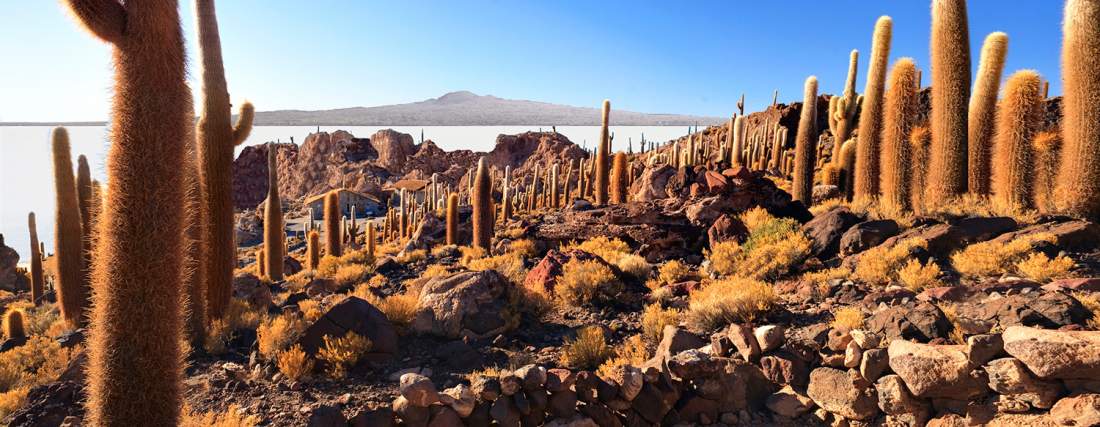
Outdoor plantings require less attention. Root freedom encourages vigorous growth, especially in columnar cacti. Heavy soils need fine bark, peat, or pumice mixed in order to aid drainage. Or better still, use a raised garden filled with free-draining mix. Against house walls is drier and warmer but be aware of potential plant size when planting near the house. Use rocks and driftwood and prospectors' skeletons for dramatic effects. Coastal conditions don't seem to bother most succulents, in fact many of them thrive in this environment. Initially, tall plants may need staking until the root system is well established.
Growing Lithops : The Living Stones.
Coloured and patterned to blend into stony, desert terrain. Lithops are the gemstones of the plant world. So difficult are they to find in the wild that only two species were known in 1900. Dedicated explorers have now discovered a total of 34 species. 14 living in Namibia and 21 in South Africa. (One in both.) Hundreds of named varieties and local forms have also been described.
Lithops is both plural and singular; there is no such animal as a 'Lithop'. Lithops consist of pairs of highly modified leaves that in habitat are usually flush with the level of the ground.
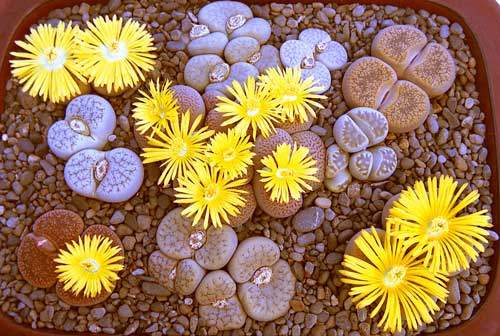
A typical member of the Mesembryanthemum family, the Lithops flower covers the body of the plant when it opens each afternoon for about 10 days in late summer/autumn. Flowers are white or yellow, several are sweetly scented. The low, rounded pebble shape is an adaptation to reduce water loss in a climate of extremely low rainfall. Another adaptation is that the seed capsule opens wide and releases a few seeds every time rain falls, then it closes again, thus spreading the chances of a successful germination. Lithops live to a great age (probably 100 years or more), with some species forming clusters of over 300 heads while others always remain solitary.
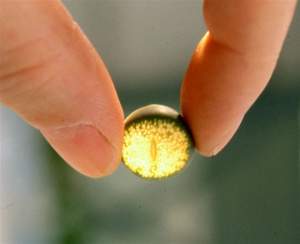
The camouflaged surface has developed because Lithops are sought after as food and water by animals like baboons and bustards. The translucent, patterned window in the top surface, however, has a double function in allowing sunlight to be captured and utilized even when the plant is withdrawn flush with the surface of the soil. In cultivation the worst pests will be root bugs, (unless you keep baboons or bustards). Root bugs require insecticide treatment and thorough washing when repotting. Mice sometimes nibble them also, especially in winter. They like the rarer ones.
Soil should be free-draining and not too high in nutrients. Excess water or excess fertilizer will cause splitting. Light must be bright but be aware that any plant can cook to death on a very hot sunny windowsill. Especially in a small volume dark-coloured pot. Tall or split Lithops have had too much water and/or not enough light. One solution is to carefully cut and peel the older outer leaves off to just above ground level with a sharp knife. You need to reduce the combined influence of (i) too much water available from the too-large older leaves and (ii) too much shade over the young growing leaves from the too-long persisting older leaves. They will look terrible for a short while, but if you don't do it they will look terrible for a long while. Without the surgery the bad cycle will just continue year after year and you will probably become suicidal. Once the new growth appears they will return to normal providing you give them ideal conditions. Multiheading or clustering will not usually begin until after the first flowering. Clusters can be pulled apart, but why bother. It takes many years to grow a decent sized plant. It's like chopping up a fifty year old bonsai to get some cuttings!
Growth cycle of Lithops.
Young Lithops up to 15mm diameter need regular light watering all year. Windowsills can be too hot for them. Mature Lithops flower some time between January and June. Give NO water after flowering or after May 31st, whichever comes first. They will wrinkle as water is withdrawn from the outside (visible) leaves and recycled into the new leaves (which may become visible down the fissure as they swell and grow). The old leaves eventually become just a dry, papery husk (around October), and gentle watering can then commence. The husk will be split by the new leaves and it can be removed to prevent shading of the new growth if it has not already blown away. Mouse nibbles and scars will now be gone, the colours are at their brightest, and the Lithops becomes once again a living gemstone. Then water moderately through summer until flowering or the end of May.
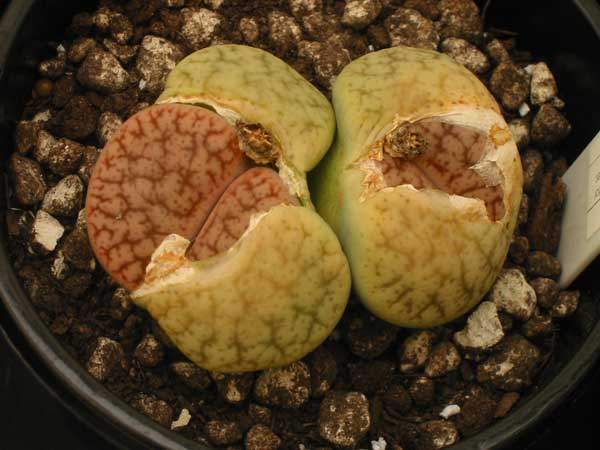
Lithops Species.
- Aucampiae grows fast and large. body to 50mm, cluster to 200mm
- Bella, 'beautiful'. Only one in both Namibia and South Africa
- Dinteri, Professor Dinter discovered four species
- Dorotheae, one of the most striking patterns.
- Fulviceps, transparent dots. Several distinct forms - red, yellow, milky grey, for example
- Hookeri, the first discovered, 1811, but not found again until 1918. Very variable
- Karasmontana, 'Karas Mountains'. Very variable
- Lesliei, widest range. many forms, easy to grow
- Naureeniae, first found as recently as 1980, big fissure
- Otzeniana, large windows, attractive curtains
- Pseudotruncatella, the earliest to flower, about December or January
- Ruschiorum, rare, smooth, white pebble. Northernmost of Lithops
- Salicola, from a salt pan in Orange Free State
- Vallis-mariae, fine, chalky wrinkles
- Verruculosa, the only Lithops with an orange flower
- Villettii, like a white-flowered otzeniana
- Werneri, smallest, 20mm in cultivation, less in Namibia Also bromfieldii, coleorum, comptonii, erniana, francisci, gesineae, geyeri, glaudinae, gracilidelineata, hallii, helmultii, herrei, julii, localis, marmorata, meyeri, olivacea, optica, schwantesii, viridis plus many minor, named variations. All are worth growing.
The Cactus Family.
Cacti are the best-known of the forty plant families with succulent species. Over 3000 types, they are all from the Americas, but New Zealand's climate can produce magnificent flowering specimens.
Cacti make their growth in summer and respond to warmth and water, but in winter they rest. From about May to September give no major waterings; but dampen soil every few weeks to prevent root dieback. Modify this according to your winter (the colder the drier).
Explorers and botanists are currently discovering more new cactus species than any other type of cultivated plant. With so many types you may wish to focus on one group in particular.
Examples:
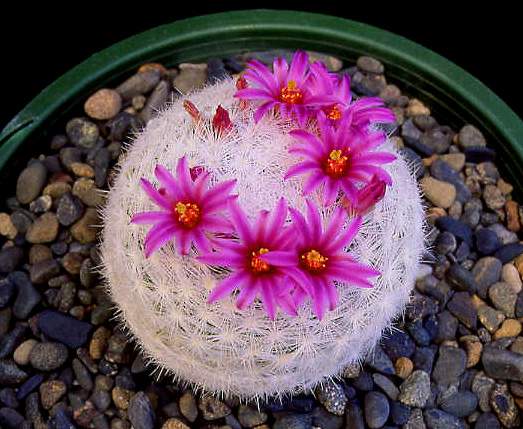
MAMMILLARIA-Small and attractive, 300 species (plus many varieties) make this the perfect genus to specialise in.
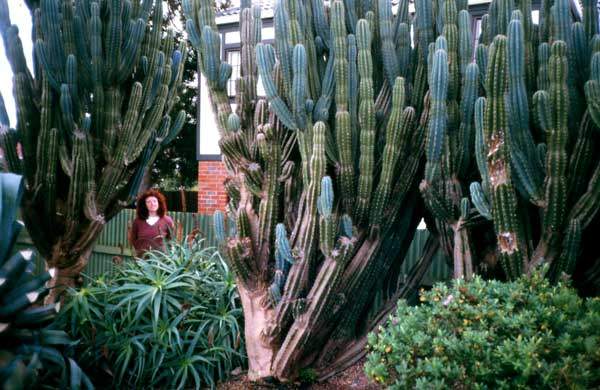
CEREOIDS are the tall columnar cacti. 100's of types, many of which grow well outdoors in NZ. Bright light if indoors, to prevent etiolation (that is, stretching and narrowing pale growth due to insufficient light). Many have scented nocturnal flowers
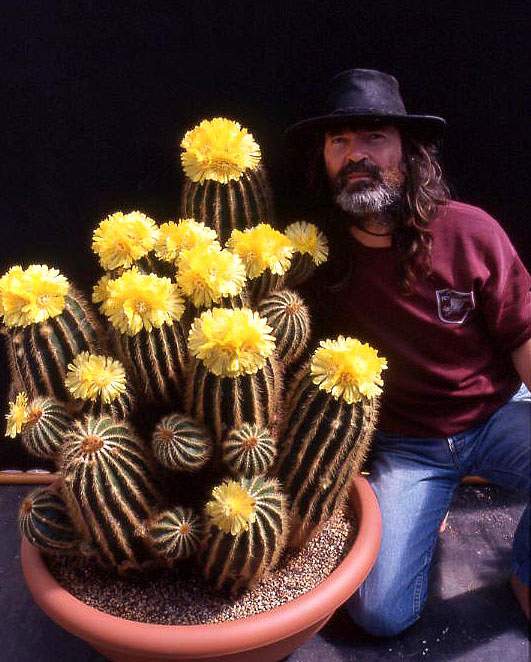
NOTOCACTUS has large flowers and is easy to grow. Of the globular types it grows faster than most.
Watering Guide.
Watch for the growing seasons of your plants but here are some guidelines for the different groups.
Water all year but less in winter:
Adromischus, Aeonium, Agave, Aloe, Cotyledon, Delosperma, Echeveria, Euphorbia, Faucaria, Gasteria, Graptopetalum, Haworthia, Huernia, Kalanchoe, Mestoklema, Pachyphytum, Portulacaria, Sansevieria, Scilla, Sedum, Senecio, Stapelia, Tacitus, Trichodiadema.
Main growth in autumn and winter:
Argyroderma, Aloinopsis, Cheiridopsis, Crassula, Frithia, Massonia, Haemanthus, Othonna, Testudinaria, Titanopsis, Veltheimea.
Pleiospilos:
Keep dry June to September inclusive. Their annual cycle is as for Lithops except the old leaves don't obscure the new. Young plants need regular water.
Conophytum:
Very gentle water in late summer to winter, then dry from mid-spring until about mid-summer. Leaves form a dry skin in spring and early summer; at this time plants may appear dead. In late summer the dead skins split open to reveal shiny new leaves.
Tylecodon:
Keep totally dry from spring until new leaves appear in late summer.
Lump Plants:
Also known as caudiciforms (with distinct caudex) and pachycauls (with thickened stem), often with non-succulent leaves. Cease watering if leaves yellow and fall in autumn or winter. Resume watering when growth resumes. e.g. Pachypodium. Testudinaria grow all year apart from a brief dormancy in mid-summer.
Need only small amounts of water: Argyroderma, Caralluma, Dinteranthus, Fenestraria, Hoodia, Lapidaria, Pseudolithos, Trichocaulon.
Care of cacti and succulents indoors.
Light.
Bright light is needed for most succulents and is especially important for blue, grey, or white plants. So keep your plants as near to the window as possible. Remember that twice as far from the window gives you only one quarter of the light level. And the growing point is where the light is needed most, that is, at the top of the plant.
If plants are wanted away from any natural light source be aware that standard electric lights scarcely count as strong light. But a high intensity growing lamp can provide the right amount. For example, a 400 watt Phillips Son-t-Agro Lamp can be mounted on the ceiling and will provide the right light environment in a cone illuminating a 1 metre circle at floor level. These are available from all Switched On Gardener outlets and are perfectly legal.
Adequate light keeps your plants in the correct shape as well as increases resistance to disease etc. Tinted glass is probably as useful as about 3 glow worms.
Water.
Avoid rewatering until soil is nearly dry. Don't allow water to stand in a saucer for more than a couple of hours after watering, but heavy watering is unnecessary as our potting mix contains a wetting agent to distribute smaller waterings evenly throughout the container. Be aware that, in less-than-adequate light, overwatering can cause etiolation and fungus attack.
For indoor heated apartments try one litre of water per week for each 600mm x 450mm pot.
Insect pests.
If insects appear kill them mercilessly. Use thumbs, insecticides etc. They are up to no good. Ants farm insects, so kill ants too. Conqueror Oil is very good on scale, mealy bugs, thrips, and aphids but plants with a glaucous or powdery bloom can be marked by it (e.g. white, blue, or grey plants). Test first.
Fertiliser.
Coromandel Cacti's standard potting mix contains an 18 month slow release fertiliser so more fertiliser is unnecessary for at least 18 months. Because the wrong combination of light, heat, water, and fertility can cause etiolated* growth we suggest no additional fertiliser at all in an indoor situation.
*** Etiolation** is the correct name for the weak, pale, stretched growth resulting from inadequate light levels. In cacti circles it is also known as the Mexican Restaurant Look.
Combinations of the following promote etiolation and are therefore to be avoided: less light, more heat, more water, more fertility.
Queries about the health or maintenance of your plants are welcomed, but please bring the problem plant to the nursery for our advice, it will save long and complicated telephone conversations.
Alternatively a photo can be sent.
We hope to be able to solve most of your cacti and succulent plant problems on this page.
Mealy Bugs.
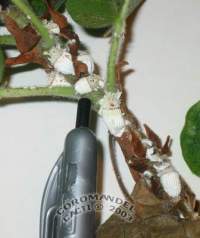
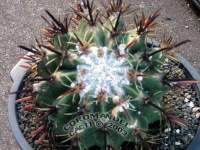
Giant Mealy Bug on Ficus petiolaris.Mealy Bug infestation in crown of Ferocactus.
Mealy bugs usually build up populations underground before becoming apparent above ground. So repot as well as spraying.
Spray with Confidor, or with Conqueror Oil. These two are not related. The latter will damage certain sensitive plant surfaces, especially powdery coated plants. And use it no stronger than 1 part in 100 of water. Test on the species first.
They can be used together for a double-barrelled approach to law and order.
Sluice roots clean of insects with high pressure water, then repot into a quality mix containing slow-releasing insecticidal Suscon Green. Our mix contains this, and we sell the mix at the nursery.
Red Spider Mite.
Microscopically small but sometimes revealed by their webbing (see picture). These little suckers cause permanent scarring and can trigger dormancy in deciduous pachycauls. They are impervious to most insecticides as they are being not an insect. Conqueror Oil sprayed at no more than 1:100 is excellent, but keen-eyed vigilance is needed to know WHEN to apply it.
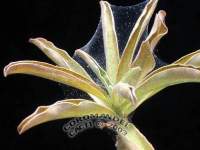
Webbing of happy Spider Mites. Leaves sucked dry will soon force this Adenium into dormancy.
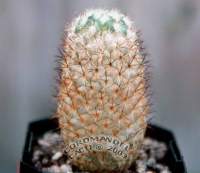
New growth is fine but the lower part of this Mammillaria is permanently mite-scarred.
Scale.
One of the worst pests on succulents, these limpet-like insects are difficult to control. They are farmed by ants, so kill the ants too. They excrete sweet honeydew, which not only feeds the ants but also grows Sooty Mildew. Try a spray program at weekly intervals with high strength chemicals or, on species that can cope, use Conqueror Oil at 1:100. If they are damp when you crush 'em they are still alive... so continue the program.
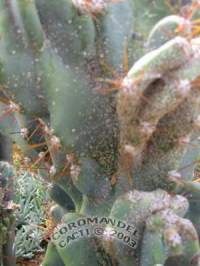
The Abdelkuri Look, actually small white scale insects.
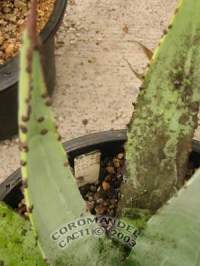
Black Scale on left, Honey Dew, and its Sooty Mildew on far leaf.
Oil Sprays.
Be aware that some succulents, especially those with a glaucous or floury leaf surface, are prone to permanent marking (damage) with oil sprays. When in doubt test first on a friend’s plant
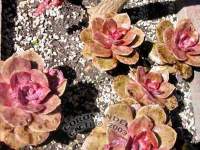
Safers Oil proved not so safe on these Echeveria.
Sunburn.
Usually a problem when moving plants into direct sun from a greenhouse or indoor situation, or having plants up against a window.
Treat your plants like a baby: would you lie it in the hot sun for hours on it’s first day outside? No, you would leave it outside first on cloudy or rainy days. If you have an east-facing location where the sun will not reach after say 9 a.m. this can be a useful place to acclimatise plants. Also a hailcloth or gauzy half-shade protection will allow acclimatization over a couple of weeks. We have not tried sunblock, but we think it would be problematic.

This plant came out of a greenhouse on a bright day and lived to regret it.
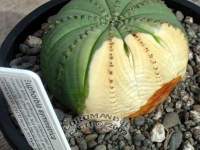
This plant was toasted on a bright windowsill just before breakfast.
Etiolation.
Etiolation is the correct name for the weak, pale, stretched growth resulting from inadequate light levels. In cacti circles it is also known as the Mexican Restaurant Look. Putting the plant out on the balcony, as in the picture below, will eventually restore the diameter of the growing point but the damage has been done and a narrow waist will be left to commemorate your plant’s misadventure.
Combinations of the following promote etiolation and are therefore to be avoided: less light, more heat, more water, more fertility.
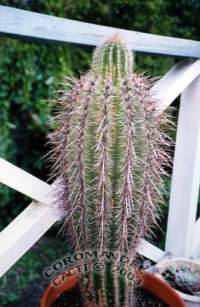
Narrowed tip tells a tale of a dark incarceration.
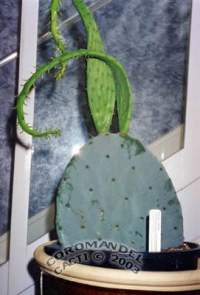
Stretching desperately to find the sunshine.
Water Deprivation.
Water Deprivation causes changes, which can tell you to give more water. The black leaf tips on Aloe plicatilis and Aloe polyphylla, for example, are caused by insufficient water. Dry leaf tips on Haworthia attenuata likewise. Careful observation of the Aloe plicatilis, however, would have revealed sunken flaccid leaves prior to the leaf tips drying off.
Note that underpottedness often gives similar symptoms.
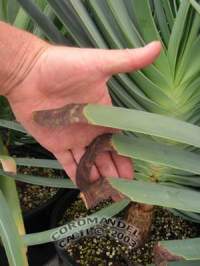
Dry black leaf tips indicate plant is too dry.

This Dinteranthus needs at least a teaspoon of water to plump it up.

Don’t be cruel: repot this plant immediately.
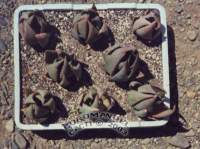
The inward-curled leaves show what torture we subjected these Aloe ortholopha to.
Heat Stress.
Not all succulents would enjoy the Mojave Desert; Sempervivums come from the European Alps after all. Air movement is important to some plants, Echeverias in particular, and Ferocactus also. Small greenhouses often need more shade to avoid overheating.
Some plants which prefer partial shade include Gymnocalycium, Haworthia, Aeonium tabulaeforme, Peperomia, Sansevieria.
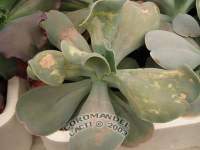
A hot greenhouse caused damage to this Echeveria.